
Job Module
Jobs live in jobs/<name>/ and mount at /jobs/{key} — shows schedule, run history, and Run Now / Cancel buttons. The module only needs a top-level Run func.
See also
For an example of a System-tagged job (auto-enabled, code-managed), see Connector Runs Purge — it's the built-in retention worker for connector audit logs.
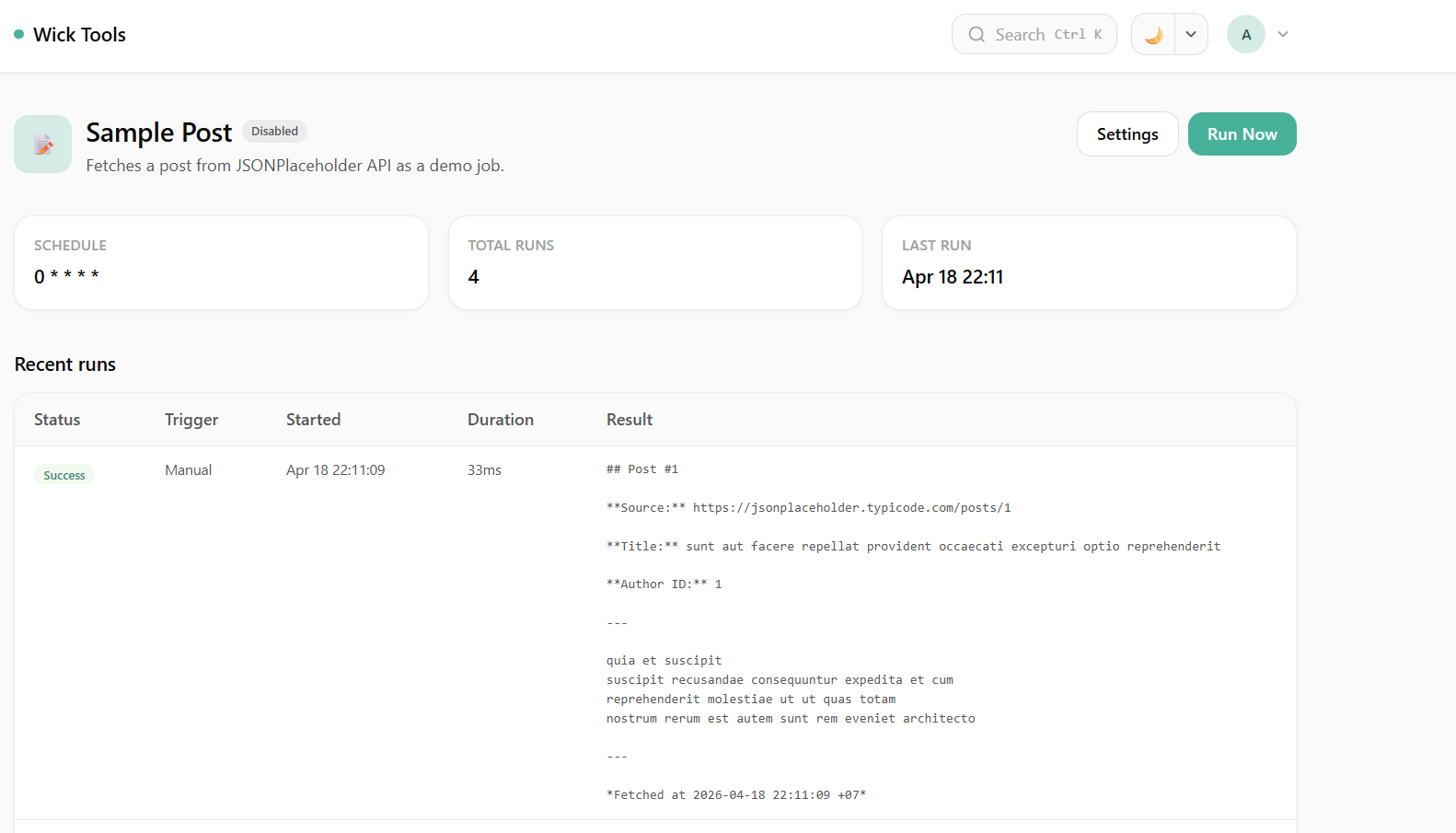 Job page — schedule info, total runs, last run time, and full run history with results.
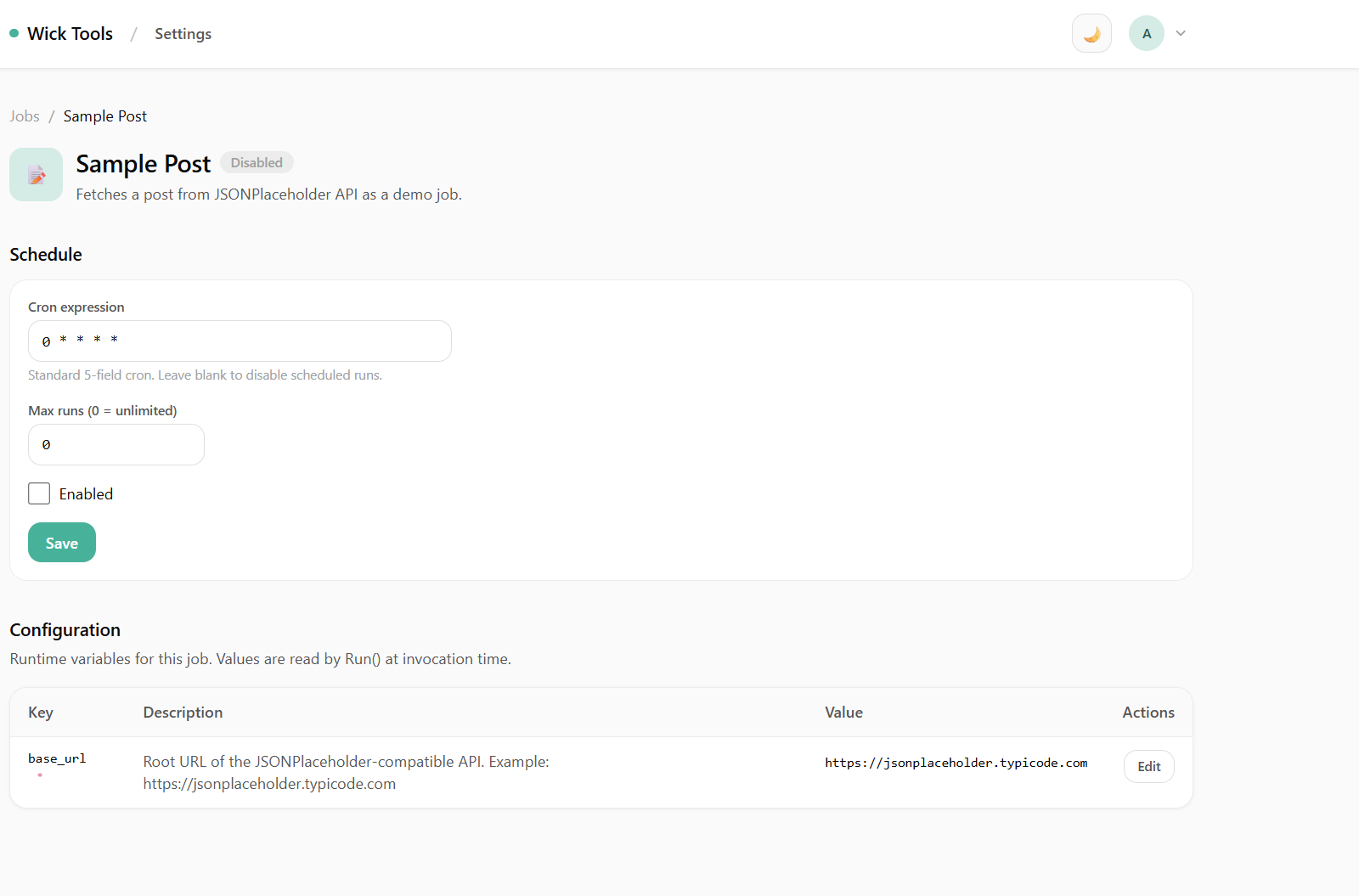 Job settings — cron expression, max runs, enable/disable, and runtime config.
File Structure
jobs/my-job/
├── handler.go    # top-level Run func
├── config.go     # typed Config struct (if job has knobs)
├── service.go    # orchestration / business logic
└── repo.go       # external I/O — DB, HTTP (optional)
Register in main.go
app.RegisterJob(
    job.Meta{
        Key:         "my-job",
        Name:        "My Job",
        Description: "Fetch remote data on a schedule.",
        Icon:        "🌐",
        DefaultCron: "*/30 * * * *",
        DefaultTags: []tool.DefaultTag{tags.Job},
    },
    myjob.Config{},
    myjob.Run,
)
For jobs with no runtime config:
app.RegisterJobNoConfig(meta, myjob.Run)job.Meta fields
| Field | Description |
|---|---|
Key | Unique slug, kebab-case |
Name | Display name |
Description | Card subtitle |
Icon | Emoji shown on card |
DefaultCron | Initial cron expression — admin can edit later |
DefaultTags | Slice of tool.DefaultTag from tags/defaults.go |
Run Function
package myjob

import (
    "context"
    "errors"
    "fmt"

    "github.com/yogasw/wick/pkg/job"
)

func Run(ctx context.Context) (string, error) {
    c := job.FromContext(ctx)

    url := c.Cfg("url")
    if url == "" {
        return "", errors.New("url not configured — set it from /manager/jobs")
    }

    n, err := fetchRemote(ctx, url)
    if err != nil {
        return "", err
    }

    return fmt.Sprintf("fetched %d bytes from %s", n, url), nil
}- Returned string → stored as the run result summary (shown in history)
- Non-nil error → marks the run as failed
Cancelling a run
A running job (/jobs/{key} on the operator page, or the job detail view in the manager SPA) shows a Cancel button while last_status is running. Cancel:
- cancels the run's context — a
Runfunc that checksctxstops promptly; - marks the open run row
cancelled(a distinct badge from Success/Error); - flips the job back to idle so the next scheduled or manual run isn't blocked.
Cancel also doubles as an unstick action: if a run crashed between finishing and updating status, leaving the job stuck showing running with nothing actually in flight, hitting Cancel (or Run Now) repairs the stale row instead of requiring manual DB surgery. The same repair runs automatically on a sweep every worker tick and at bootstrap, including for disabled jobs.
Disabling a running job (from job settings) cancels its run the same way — a disabled job never keeps executing in the background.
A Run func that ignores ctx keeps running until MaxTimeoutMin regardless — Cancel stops the job from appearing to run and unblocks future triggers immediately, but the goroutine itself only stops early if it respects context cancellation.
Runtime Config
Same wick:"..." tag grammar as tools — see the Config Tag Reference for the full widget table and all flags.
package myjob

type Config struct {
    URL    string `wick:"desc=Endpoint to fetch.;url;required"`
    APIKey string `wick:"desc=Bearer token.;secret"`
    Limit  int    `wick:"desc=Max records per run.;number"`
}
Read inside Run:
c := job.FromContext(ctx)
url    := c.Cfg("url")
apiKey := c.Cfg("api_key")
limit  := c.CfgInt("limit")
Worker vs Web
Both processes share the same configs table. Admin edits take effect on the next cron tick.
| Process | Command | Responsibility |
|---|---|---|
| Web | go run . server | Mounts /jobs/ and /manager/jobs/ pages |
| Worker | go run . worker | Runs cron ticker, invokes Run on schedule |
go run . dev starts only the web process. Run go run . worker in a second terminal for job execution during development.