
Connector Module
Connectors are the third class of wick module beside Tools and Jobs. They wrap one external API and expose it to LLM clients (Claude, Cursor, custom agents) over MCP. Where Tools are designed for humans clicking a UI and Jobs run on a schedule, connectors exist so an LLM can call your APIs with structured input/output and full audit logging — no protocol code on your side.
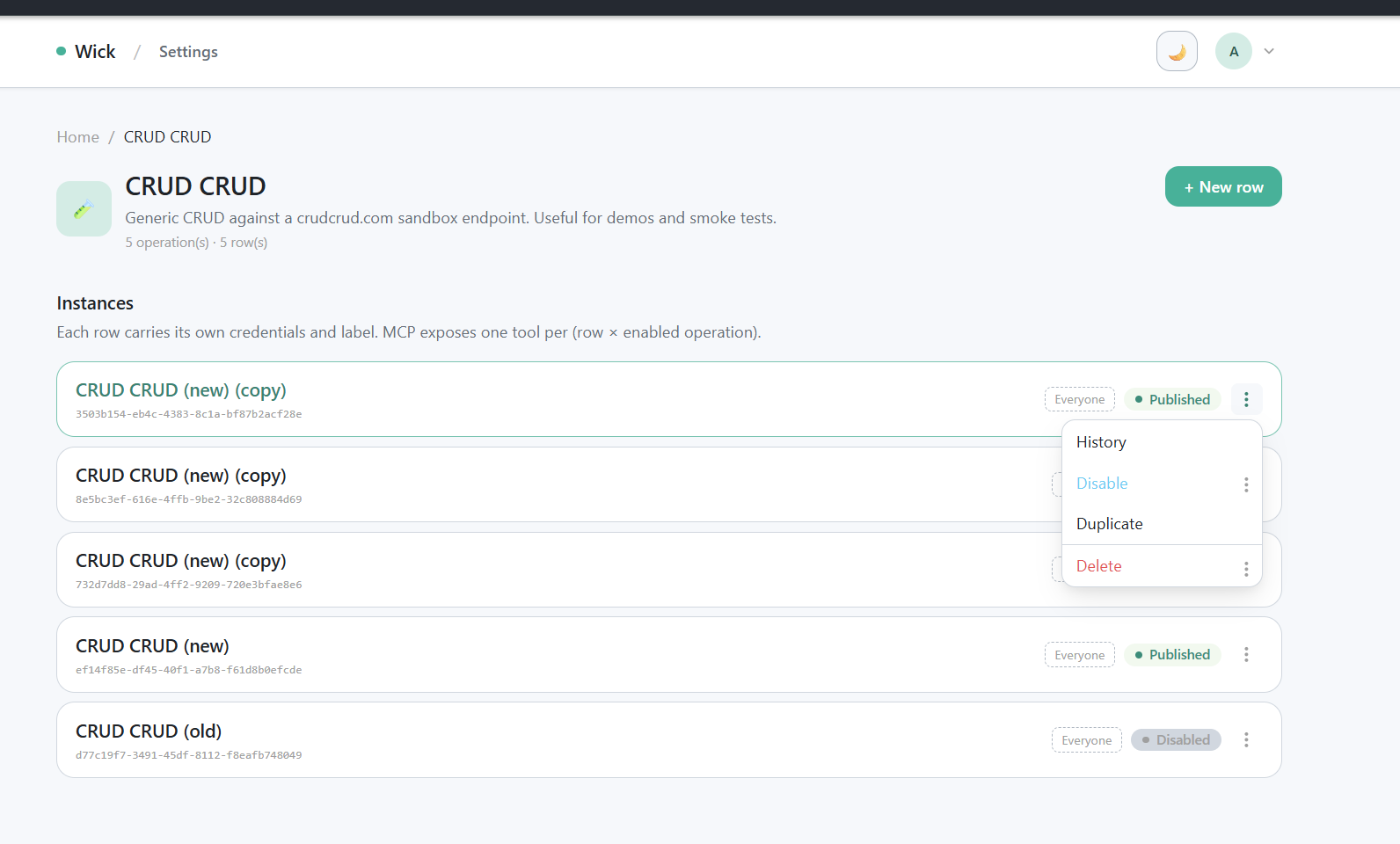
/manager/connectors/{key} list page with stacked rows + tag chips + kebab menu.
Mental model
- One connector module wraps one external API.
- It carries one shared
Configsstruct (URL, token, …) plus NOperations— small, named actions an LLM can call (query,list_repos,create_issue). - Each operation has its own typed
Inputstruct (turned into MCP JSON Schema) and its ownExecuteFunc. - An admin can spawn many rows per definition at runtime through
/manager/connectors/{key}— each row carries its own credentials, label, and tags. Same Go code, different rows = different (env, team, account). - LLMs do not see N×M static tools. The MCP server exposes a fixed meta surface (
wick_list,wick_search,wick_get,wick_execute); each (row × operation) pair is addressed by an opaquetool_idof the formconn:{connector_id}/{op_key}. See the MCP guide for the full transport story.
Before you build
Before writing a single line, lock down the API contract. Connectors are LLM-facing and the wrong shape costs more to fix than to gather upfront. Ask the user (or skim the upstream docs yourself) for:
| What to gather | Why it matters |
|---|---|
| Endpoint + auth — base URL, auth scheme (bearer token, basic, header key, OAuth), required scopes | Becomes the Configs struct. Auth scheme decides whether one credential field is enough or you need several. |
| One concrete sample request per operation — method, URL, headers, query params, body | Drives the Input struct shape and the request builder in repo.go. Don't guess from a description. |
| One concrete sample response per operation — both happy path and a typical error | Drives the typed return shape and the error parser. Upstream error envelopes differ wildly; pick the wrong field and run history shows blank errors. |
| Which ops mutate state — and how reversible each one is | Decides Op vs OpDestructive. Destructive ops default off on every new row; missing the flag means the LLM can fire them silently. |
| Pagination, rate limit, retry quirks | Decides whether the op needs a cursor/page input, and whether to surface limit headers as errors instead of swallowing them. |
| Default tags — public to every approved user, or restricted by filter tag? | Every new connector ships with tags.Connector (group-only) so it appears under the "Connector" group on the home page — set this in Meta.DefaultTags. Filter tags (tags.System etc.) require an explicit ask; never add one on your own initiative. |
Paste the sample request/response into the conversation before coding. It is much easier to align on shape with a real payload in front of you than to reverse-engineer it from prose.
File structure
Connectors mirror the tool module split — three files, one job each:
connectors/my-connector/
├── connector.go    # Meta + Configs + per-op Input structs + Operations() + thin op handlers
├── service.go      # pure Go logic — input validation, URL/body construction, response shaping
└── repo.go         # outbound I/O — HTTP calls, DB, S3 (everything that touches the network)
Why split:
connector.gostays scannable. A reader can read Meta, Configs, every Input struct, every Operation description, and the dispatch shape of every handler without scrolling past validation logic or HTTP wiring.service.gois unit-testable in isolation. Validators and URL builders take a*connector.Ctx(or plain values) and return data — no network, no fixtures, fast tests.repo.gois where the goroutine-leak rule lives. Concentrating everyhttp.NewRequestWithContextcall in one file makes the rule easy to enforce and easy to audit.
Handlers in connector.go should read like a five-line outline: validate via service.go, dispatch via repo.go, return. Anything that grows beyond "parse, validate, dispatch" belongs in service.go.
The shipped example connectors/crudcrud/ follows this layout — five operations including one destructive, end-to-end.
Register in main.go
import "<projectmod>/connectors/myconnector"

app.RegisterConnector(
    myconnector.Meta(),
    myconnector.Configs{
        BaseURL: "https://api.example.com", // seed; admins can change after first boot
    },
    myconnector.Operations(),
)
One call = one connector definition. Wick auto-seeds one empty row in the connectors table on first boot. Admins fill in the credential values at /manager/connectors/{key}/{id} before any operation can run.
- Existing rows are never overwritten on subsequent boots.
- Two registrations with the same
Meta.Keycause a fatal boot error. - A
Keywhose module backing has been removed is tolerated: the row stays in the DB, marked "Module not registered" in the admin UI; calls return an error.
Connector contract
Meta()
func Meta() connector.Meta {
    return connector.Meta{
        Key:         "github",
        Name:        "GitHub",
        Description: "Read repos, issues, and pull requests on GitHub.",
        Icon:        "🐙",
        DefaultTags: []tool.DefaultTag{tags.Connector},
    }
}| Field | Description |
|---|---|
Key | Unique slug across all connectors. Drives the admin URL /manager/connectors/{Key} |
Name | Display name on the admin card and detail page |
Description | Shown to admins. The LLM never reads this — see per-Operation Description below |
Icon | Emoji or short string |
DefaultTags | Tags attached to every freshly seeded row. Every connector should include tags.Connector so the home page groups it under "Connector". Add module-specific tags on top of that (e.g. tags.System for built-in maintenance connectors). Admin unlinks survive restarts — boot only seeds when a row has zero tag links yet. |
Fixed | When true, only one row may exist for this Key. Useful for connectors backed by a single in-process resource. |
Configs struct
Per-instance credentials and endpoints, shared across every operation. Reflected by entity.StructToConfigs into the admin form.
type Configs struct {
    BaseURL string `wick:"url;required;desc=GitHub API base URL. Default: https://api.github.com"`
    Token   string `wick:"secret;required;desc=Personal access token with the scopes you intend to use."`
}
The wick:"..." tag grammar is shared with Tools and Jobs. See the Config Tag Reference for the full widget table and all flags. Common modifiers:
| Tag | Effect |
|---|---|
required | Admin must fill before any op can run |
secret | Masked in the UI and marks the field for plaintext auto-mask in the encrypted-fields layer. Round-tripping a wick_enc_ token through any field (secret-tagged or not) is now covered automatically — every plaintext produced by decrypting an incoming token is re-masked on the way out. The secret tag is still the right signal whenever the field can also be filled in plaintext (e.g. by an admin pasting a raw credential into the form). |
url, email, textarea, dropdown=a|b|c, kvlist=col1|col2 | Widget overrides |
desc=... | Help text shown next to the field |
key=custom_name | Override the snake_cased field name |
Read at runtime via c.Cfg("base_url"), c.CfgInt("port"), c.CfgBool("use_tls"). Reads always return plaintext — the encrypted-fields layer happens around ExecuteFunc, not inside it. For sensitive values that come back from the upstream API and aren't declared as Configs/Input fields, mask them yourself with c.Mask(data, values) (or c.MaskIgnoreCase for case-folded matching) before returning. Every value passed to c.Mask is also remembered for the framework's post-Execute auto-mask sweep, so the same value leaking into a different response field gets masked too — no need to thread it through every site manually.
Per-operation Input structs
Each operation has its own input schema. Same tag grammar; the framework reflects each one into the JSON Schema the MCP client sees in wick_get.
type ListReposInput struct {
    Org        string `wick:"required;desc=Organization login. Example: anthropics"`
    Visibility string `wick:"dropdown=all|public|private;desc=Filter by repo visibility."`
    PerPage    int    `wick:"desc=Page size (1-100). Default 30."`
}
Read at runtime via c.Input("org"), c.InputInt("per_page"), c.InputBool("include_archived").
Operations()
func Operations() []connector.Operation {
    return []connector.Operation{
        connector.Op(
            "list_repos",
            "List Repositories",
            "List repositories under {org}. Returns repo name, full_name, default_branch, visibility, and updated_at.",
            ListReposInput{},
            listRepos,
        ),
        connector.OpDestructive(
            "close_issue",
            "Close Issue",
            "Close the given issue on {owner}/{repo}. Reversible only by reopening; comments and history are preserved.",
            CloseIssueInput{},
            closeIssue,
        ),
    }
}| Constructor | When to use |
|---|---|
connector.Op(...) | Read-only or idempotent writes that can be safely retried |
connector.OpDestructive(...) | Actions you do not want the LLM to fire by mistake — DELETE, send-message, post-comment, force-push |
A destructive op is disabled by default on every new row. Admins opt in per (row, operation) at /manager/connectors/{key}/{id}.
Description discipline
Operation.Description is load-bearing: it appears verbatim in the MCP wick_list / wick_search payload and is the primary signal an LLM uses to decide whether to call the op.
Write action verbs and be specific:
- ✅ "Search Loki using LogQL. Returns log lines with timestamp + labels. Empty result = empty array."
- ✅ "Send a Slack message to {channel}. Returns the posted message timestamp on success."
- ❌ "query loki"
- ❌ "send slack"
ExecuteFunc
func listRepos(c *connector.Ctx) (any, error) {
    org := strings.TrimSpace(c.Input("org"))
    if org == "" {
        return nil, errors.New("org is required")
    }

    base := strings.TrimRight(c.Cfg("base_url"), "/")
    url := fmt.Sprintf("%s/orgs/%s/repos", base, org)

    req, err := http.NewRequestWithContext(c.Context(), http.MethodGet, url, nil)
    if err != nil {
        return nil, fmt.Errorf("build request: %w", err)
    }
    req.Header.Set("Authorization", "Bearer "+c.Cfg("token"))
    req.Header.Set("Accept", "application/vnd.github+json")

    resp, err := c.HTTP.Do(req)
    if err != nil {
        return nil, fmt.Errorf("call github: %w", err)
    }
    defer resp.Body.Close()
    raw, _ := io.ReadAll(resp.Body)
    if resp.StatusCode < 200 || resp.StatusCode >= 300 {
        return nil, fmt.Errorf("github %d: %s", resp.StatusCode, strings.TrimSpace(string(raw)))
    }

    var out []struct {
        Name          string `json:"name"`
        FullName      string `json:"full_name"`
        DefaultBranch string `json:"default_branch"`
        Visibility    string `json:"visibility"`
    }
    if err := json.Unmarshal(raw, &out); err != nil {
        return nil, fmt.Errorf("decode response: %w", err)
    }
    return out, nil
}
Ctx helpers
| Helper | Description |
|---|---|
c.Cfg("key") | Read a credential / config value (string) |
c.CfgInt("key") | Same, parsed as int (0 on parse failure) |
c.CfgBool("key") | Same, parsed as bool (true/1/yes/on) |
c.Input("key") | Read an LLM-supplied input (string) |
c.InputInt("key") | Same, as int |
c.InputBool("key") | Same, as bool |
c.Context() | The cancellation context. Always pass into http.NewRequestWithContext |
c.HTTP | Default *http.Client with a 30s timeout |
c.InstanceID() | Connector row ID — useful for structured logging |
c.ReportProgress(progress, total, message) | Emit progress for long-running calls (no-op on JSON transport) |
Best practices
http.NewRequestWithContextis mandatory. Plainhttp.NewRequestleaks the goroutine when an MCP call is cancelled (client disconnect, deadline). This is the single most common bug in custom connectors.- Validate input early. Do presence and bound checks before the HTTP call so the error message lands cleanly in the run history.
- Wrap upstream errors with
%w. The error chain is rendered in the history detail panel;errors.Is/errors.Askeeps working downstream. - Return typed shapes when you can. A struct with explicit
json:tags gives the LLM a clean, stable schema independent of upstream cosmetics. Returning the raw upstream body works but breaks the moment upstream tweaks its envelope. - Mark destructive ops. Anything that mutates state in a hard-to-undo way — DELETE, post, send, force-push — should be
OpDestructive. This defaults the toggle off on every new row.
Anti-patterns
- ❌
http.NewRequest(no context) — goroutine leak. - ❌ Returning
*http.Response.Bodyreader directly — the framework cannot marshal it. Alwaysio.ReadAll+ decode. - ❌ Storing config values in package-level vars — connectors are multi-row; every call must read fresh from
c.Cfg(...). - ❌ Op keys with hyphens or spaces — slug only (
a-z0-9_). - ❌ Sharing mutable state across
Executeinvocations — concurrent calls. - ❌ Polling tight loops without honoring
c.Context().Done().
Per-row management UI
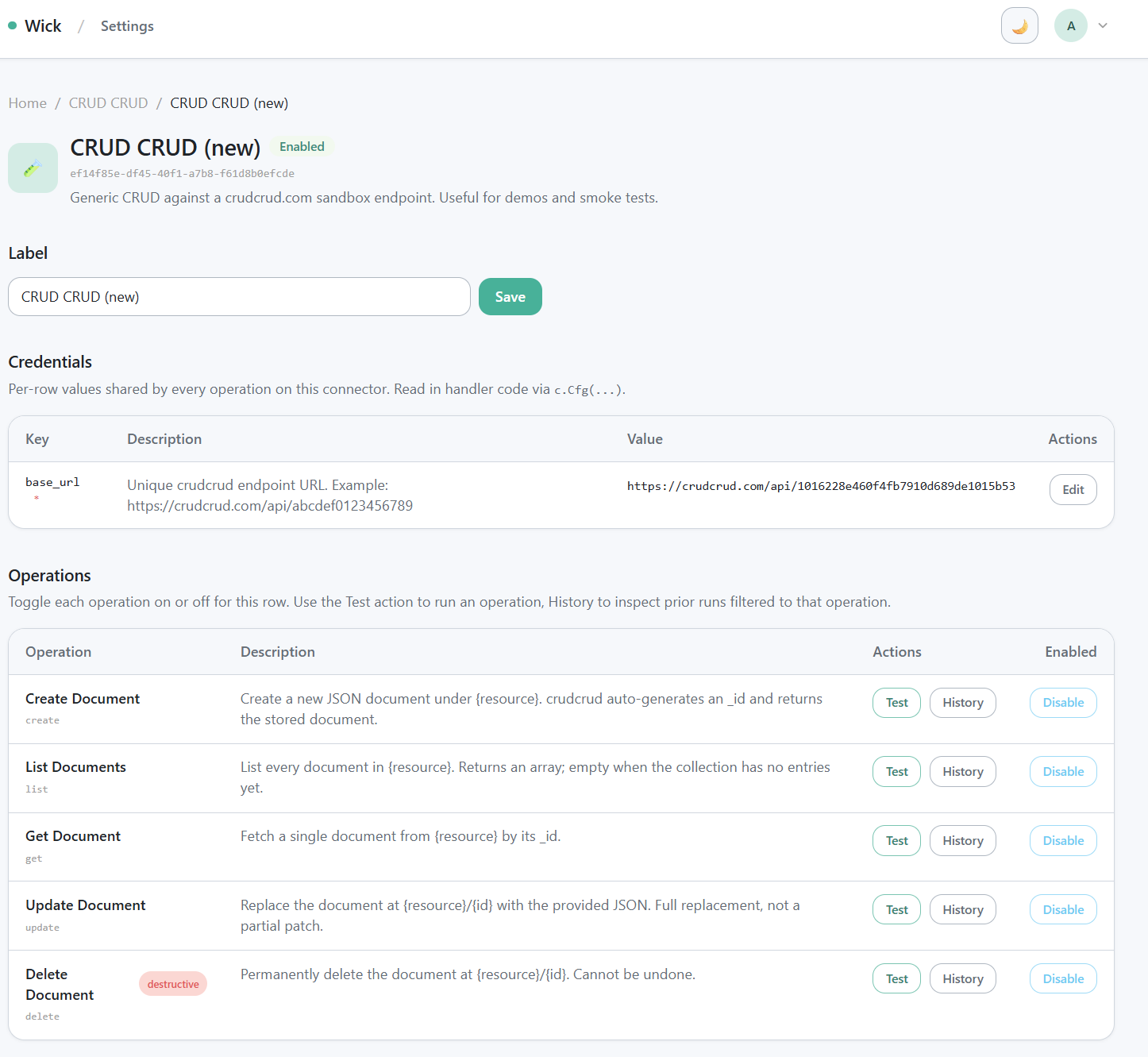
/manager/connectors/{key}/{id} detail page — identity, action bar, label form, credentials, operations table.
/manager/connectors/{key}/{id} is the per-row settings page. Five sections:
- Identity — label, status badge, opaque row ID.
- Top actions — History, Duplicate, Disable/Enable, Delete.
- Label form — rename without redeploying.
- Credentials — auto-rendered from your
Configsstruct viaentity.StructToConfigs. - Operations table — one row per operation. Each row carries:
[Test]link → opens the test panel (/test?op=<key>)[History]link → opens the audit log filtered to that opEnable / Disabletoggle — admins explicitly opt in to destructive ops here.
Test panel (Postman-style)
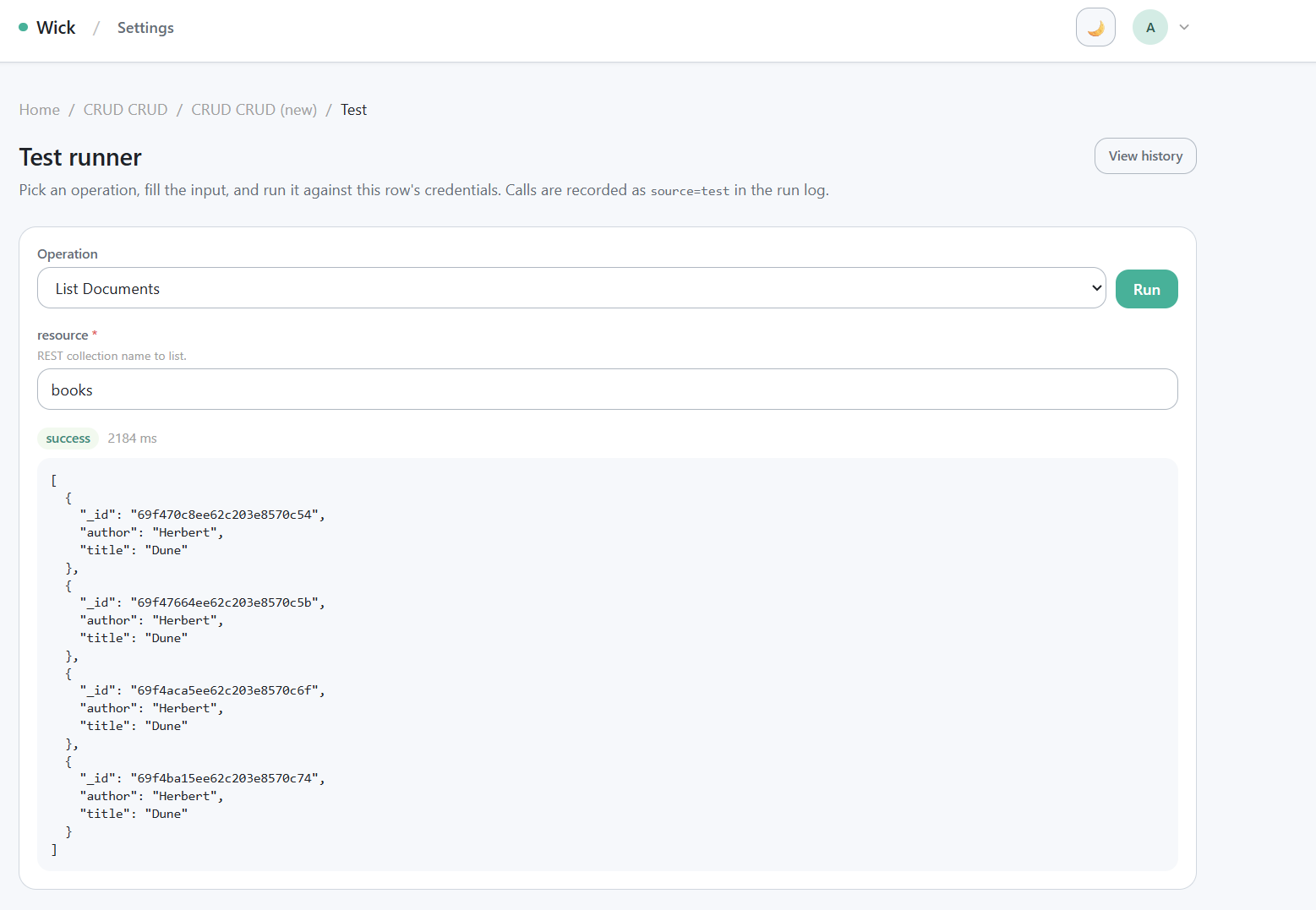
/manager/connectors/{key}/{id}/test?op=... Postman-style runner — input form + Run button + success result panel.
GET /manager/connectors/{key}/{id}/test?op=<op_key> is the in-app runner. It uses the exact same code path as the MCP tools/call — verify behavior end-to-end without leaving the browser.
- URL-synced operation dropdown — switching the operation rewrites
?op=...viahistory.replaceState. Refresh and back-button preserve the choice; deep links from the detail page can pre-select. - Prefill from history — the History page's "Retry" link points at
/test?op=<op>&prefill=<run_id>. The handler decodes the prior run's input and pre-fills every matching input field. You review and edit before clicking Run — never auto-replay. - Every Run writes a row to
connector_runs(source =test).
History page
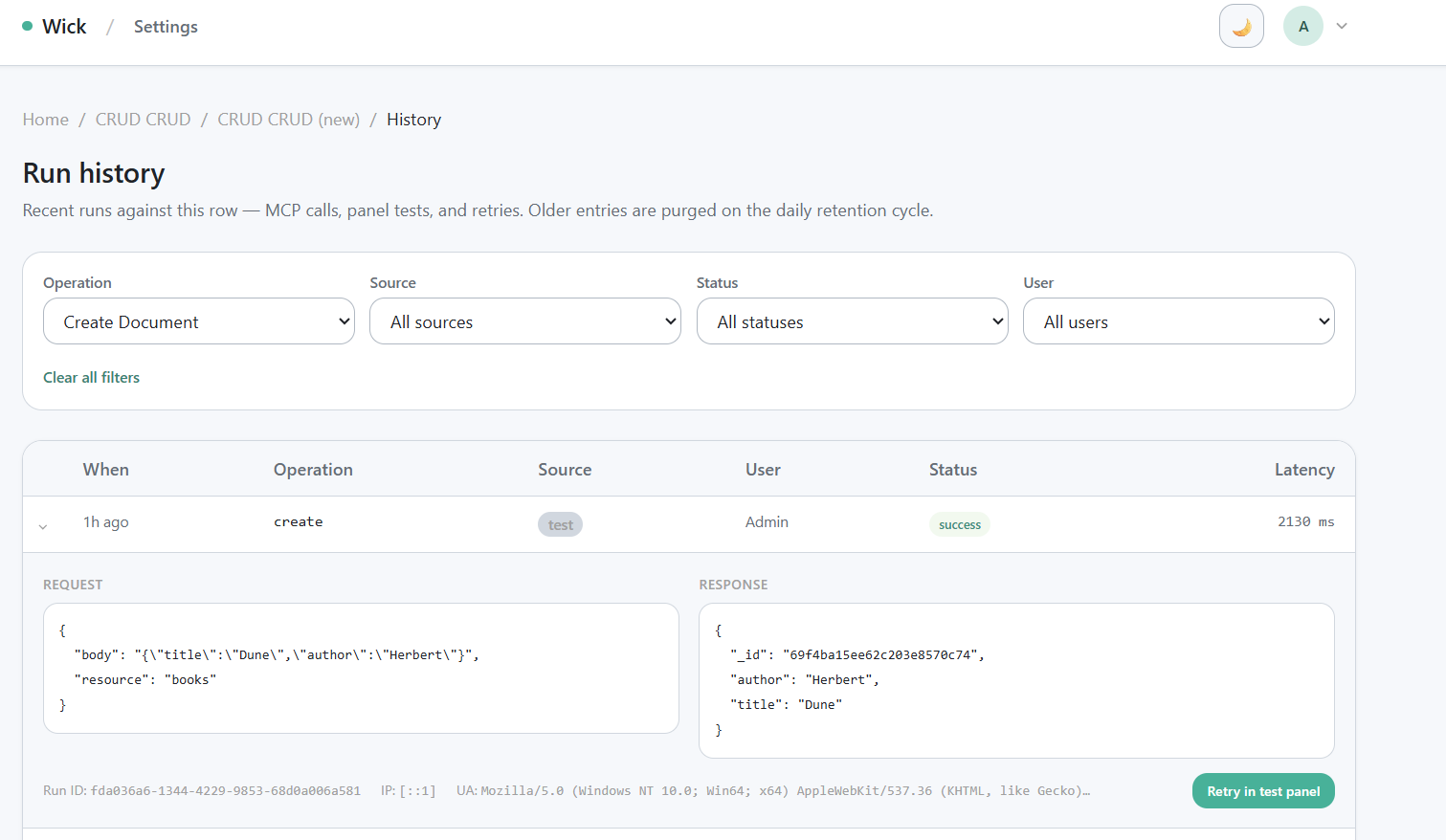
/manager/connectors/{key}/{id}/history audit log — filter chips + table + expanded row showing Request/Response JSON + Retry link.
GET /manager/connectors/{key}/{id}/history?op=...&source=...&status=...&user=... is a paginated audit log.
- Filter chips are URL-driven — every change rewrites the query string. Links are shareable; refresh preserves filters.
- 10 rows per page, server-side pagination.
- The User column resolves IDs to display names in batch (no N+1 queries).
- Click a row to expand inline — full Request JSON, Response JSON, run ID, IP, user agent, and HTTP status, no extra round trip.
- The expanded panel includes a "Retry in test panel" link that navigates to the test page with the prior input prefilled. Manual replay only — wick deliberately does not offer a one-click POST replay so you can review and adjust before re-running.
Sharing connectors with tags
Every connector row is private by default at the transport level — the /mcp endpoint always requires a bearer token; there is no anonymous access. Within authenticated users, visibility is gated by tag filter (the same mechanism Tools and Jobs use):
- A row with 0 filter tags is visible to every approved user.
- A row with ≥1 filter tag is visible only to users who carry at least one matching tag.
- Admins bypass the filter — they always see every row.
Tag strings are arbitrary and admin-defined. Conventional prefixes like team:platform, env:prod, user:alice@example.com are just naming conventions, not enforced by code.
When the user asks for a "private" connector:
- If they mean "not exposed to anonymous users" — that's already the default, no action needed.
- If they mean "only people on team X" — add a filter tag. Apply the tag both to the connector row (at
/manager/connectors/{key}/{id}) and to the team members' user records (at/admin/users).
The fixed MCP tools wick_list, wick_get, and wick_execute re-check tag visibility on every call — they never trust a list-time cache. Removing a user's tag takes effect on the next call.
Verifying your connector
After registering and filling credentials:
- Compile and boot:bash
wick dev - Smoke test in the browser:
- Open
/manager/connectors/{key}— your auto-seeded row appears. - Open the row, fill in
Configs, save. - Open
/test?op=<op>, fill input, click Run, confirm a success result.
- Open
- Check the audit log:
- Open
/history, find the run row. - Expand to confirm Request/Response JSON, latency, and run ID.
- Open
- Smoke test from MCP (optional but recommended):
- Generate a Personal Access Token at
/profile/tokens. - Add to your Claude Desktop config — see the MCP guide for the snippet.
- Restart Claude Desktop, ask it to call your connector.
- Generate a Personal Access Token at
Reference
- Public API:
pkg/connector—Meta,Module,Operation,Op,OpDestructive,ExecuteFunc,Ctx - Canonical example:
connectors/crudcrud/— three-file split (connector.go+service.go+repo.go) - MCP transport: MCP for LLMs
- Auth modes: Access Tokens (PAT), OAuth Connections
- Audit retention: Connector Runs Purge